
A just energy transition involves investment in cleaner technologies and stopping highly polluting activities, increasing jobs in some sectors and reducing them in others, changes in behaviour and systems by actors at all level in the energy ecosystem: investors, workers, managers, regulators, innovators and consumers.
These changes need to be supported by a variety of policy instruments, spanning everything from emissions pricing that accelerates renewables to reshaping markets and infrastructure to measures for overcoming non-price barriers to decarbonization, social protections that support the wellbeing of communities, and mechanisms for enhancing international climate cooperation.
We have an open research agenda that prioritizes integrated policy approaches to the interaction between price and non-price measures for supporting just energy transitions in the Global South.
We are directing policy research, evaluation and engagement to:
- Develop innovative economic and policy solutions and shape narratives among decision-makers and stakeholders that improve the feasibility and effectiveness of emissions pricing and other policies in supporting just energy transitions in the Global South
- Support the social, technical and financial aspects of accelerated energy transitions and enable more effective use of both price and non-price measures
- Analyze data and apply econometric tools to evaluate the impacts of policy efforts in the context of the Global South so they can be improved and others can learn from them.
- Align research and engagement outputs with decision-making cycles and local governance needs
- Reframe dominant narratives on just energy transitions, emissions pricing and international cooperation through Global South lenses
- Build coalitions across sectors and geographies
- Leverage digital technology for collaboration, transparency, and scale
Key focus areas for our research and engagement on policy design and evaluation include:
- Aligning incentives
- What is a just transition?
- Policies to reduce barriers to transition: including R&D policy; electricity pricing
- International co-operation
Holistic climate mitigation policies
Achieving systemic mitigation goals requires effective governance, including long-term commitment, clear priorities, strategic planning, and significant upfront funding. For example, Vietnam and Indonesia have shown how robust governmental engagement can lead to successful electrification outcomes. Kenya, which scored above the Sub-Saharan African average in government effectiveness, began receiving support from the African Development Bank in 2015 for the “Last Mile Connectivity Project”, aiming to expand electricity access. With local government involvement, Kenya was able to leverage these investments to achieve higher rates of electricity access, showcasing how a holistic national plan can amplify the benefits of climate finance (Lee 2016).
Achieving ambitious goals also requires shifts in policy, infrastructure, the workforce and in market structures. The electricity sector ‘mitigation avocado’ below illustrates a holistic climate mitigation plan for the electricity sector.
The ‘seed’ represents foundational mitigation projects including building renewable energy and storage facilities, electrifying buildings and industrial processes, improving the efficiency of fossil fuel facilities that must continue to operate during the transition, and accelerating the closure of unnecessary and inefficient plants.
The electricity sector ‘mitigation avocado’
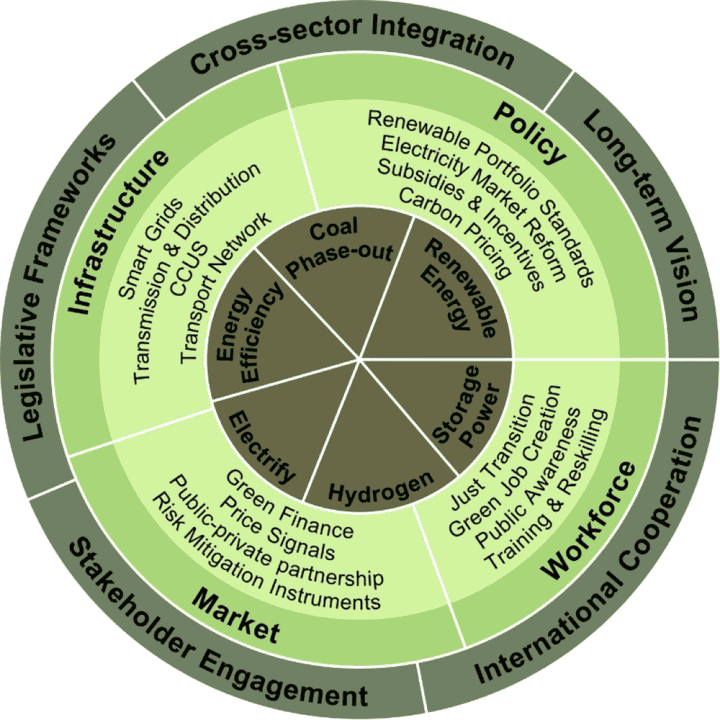
The “flesh” corresponds to the broader supportive economic, political, and social environment necessary to nurture the ‘seed’. This entails:
- regulatory reforms that eliminate barriers to profitable renewable electricity generation, and policies, possibly including local carbon pricing, that induce a high level of renewable energy demand and efficient dispatch
- infrastructure investments and grid management for a more decentralised, reliable, and renewable-focused energy system
- long-term power purchase agreements to reduce transaction costs, stable pricing mechanisms, green bonds, and risk-sharing instruments that improve revenue certainty and lower the cost of capital
- developing the capacity of workers to provide the skilled labour needed and supporting individuals and communities affected by closure of fossil fuel plants, mines, and wells
The ‘skin’ symbolizes overarching visions and coordination of the critical institutional framework. Institutions include climate targets and monitoring, and planning and governance institutions (e.g., Climate Commissions) that coordinate different sources of finance, and technical and capacity support at the national or even global scale, and facilitate social processes to inform and shape the national or sectoral visions for a low-emissions future and provide the social license governments need to act in an ambitious and sustained way.
The proportions may vary across countries depending on specific contexts and priorities.
Many stakeholders would benefit significantly from energy transitions that are adequately informed, planned, and resourced.
These include:
- Future generations who will bear the consequences of climate delays
- Companies, innovators and investors with the potential to create and use new renewable energy
- Investors (public or private) in traditional fossil fuel assets who face uncertainty about their long-term use and value.
- Countries, communities and workers that would benefit from low-emission investment and new jobs
- Communities affected by pollution, energy exclusion, or insufficient access to secure and sustainable energy services
- Communities which will face abrupt and unjust energy transitions if they are not planned
The potential facilitators of energy transitions would also benefit. These include:
- Policymakers who are tasked with meeting challenging goals but lack access to good tools and information, country-specific policy design options, and skilled analysts on policy design
- Technical professionals within governments and public institutions, whose autonomy and growth are limited by reliance on external inputs
- National technical teams lacking tools and institutional recognition.